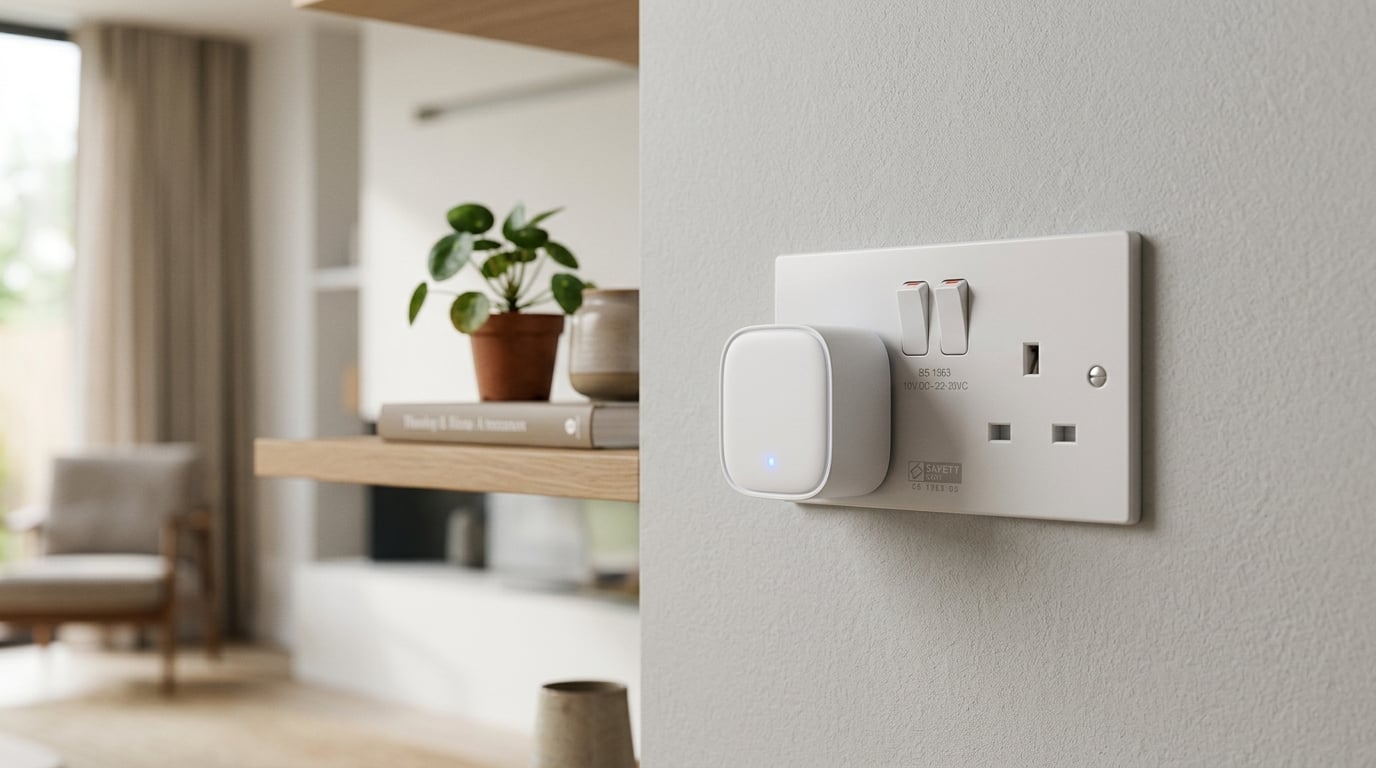
Why Smart Plugs Are the Smartest Starting Point for Any UK Home
If you're looking to dip your toes into the world of smart home technology without spending a fortune, smart plugs are the perfect entry point. Affordable, easy to install, and genuinely useful, a good smart plug can transform any ordinary appliance into a connected device — no electrician required. In 2026, the UK market is brimming with excellent options, from budget-friendly basics to premium Matter-certified models with full energy monitoring.
With UK electricity prices remaining a significant household concern, smart plugs with energy monitoring have become particularly popular. The Energy Saving Trust estimates that standby power costs the average UK household between £35 and £86 per year — and smart plugs are one of the most effective tools for identifying and eliminating that waste. In this buying guide, we'll walk you through everything you need to know to choose the right smart plug for your home.
What to Look for When Buying a Smart Plug in the UK
Before diving into specific product recommendations, it's worth understanding the key features that separate a great smart plug from a mediocre one. Here's what UK buyers should prioritise in 2026:
Matter Compatibility
Matter is the new universal smart home standard, backed by Apple, Amazon, Google, and Samsung. A Matter-certified smart plug will work natively with Apple Home, Amazon Alexa, Google Home, and SmartThings — without needing a proprietary hub or being locked into a single ecosystem. Look for the Matter logo or an "M" suffix in the model name (such as the Tapo P110M). Buying Matter-certified devices future-proofs your smart home investment.
Energy Monitoring
Not all smart plugs include energy monitoring, but for UK households watching their electricity bills, it's an invaluable feature. A plug with energy monitoring shows you real-time wattage draw and cumulative kilowatt-hour (kWh) usage. The best apps let you input your pence-per-kWh tariff so you can see exactly what each appliance is costing you. This is particularly useful for identifying "energy vampires" — devices that silently drain power on standby.
Physical Design and UK Socket Compatibility
UK wall sockets (BS 1363 Type G) are often found in pairs on a double wall plate, and a bulky smart plug can easily block the adjacent socket. Always look for "slimline" designs that are specifically engineered to fit UK double sockets without obstructing the second outlet. Manufacturers like TP-Link and Meross have paid close attention to this, and their plugs are designed with UK socket dimensions in mind.
Safety Ratings and Load Capacity
Most standard UK smart plugs are rated for 13A (approximately 2,990W–3,120W), which is sufficient for the vast majority of household appliances. However, for high-draw devices such as tumble dryers, electric heaters, or electric kettles used continuously, you'll want a plug rated for 16A (3,680W). Always ensure any smart plug you purchase carries UKCA or CE safety markings, confirming it meets UK and European safety standards.
Voice Assistant and App Compatibility
Check that your chosen plug works with your preferred voice assistant — whether that's Amazon Alexa, Google Assistant, or Apple Siri. Also consider the quality of the companion app: a well-designed app makes scheduling, automation, and energy tracking far more enjoyable to use day-to-day.
The Best Smart Plugs Available in the UK in 2026
Here are our top picks across different budgets and use cases, all available from major UK retailers including Amazon UK, Currys, John Lewis, and Argos.
1. TP-Link Tapo P110M — Best Overall
Price: approximately £9.99–£12.99 (single) | £29.99–£32.99 (4-pack)
The TP-Link Tapo P110M is the standout choice for most UK households in 2026. It's the Matter-certified successor to the hugely popular P110, and it improves on its predecessor in almost every way. The slimline design fits neatly into UK double wall plates without blocking the adjacent socket, and the energy monitoring dashboard is clean, accurate, and easy to read.
Matter certification means it works natively with Alexa, Google Home, and Apple HomeKit without any proprietary hub. You can input your exact pence-per-kWh tariff into the Tapo app to track real-time costs, making it an excellent tool for identifying standby waste. Available from Amazon UK, Currys, and Argos.
- Pros: Matter certified, excellent energy monitoring, slimline UK design, great value, no hub required
- Cons: Tapo app requires an account, 2.4GHz Wi-Fi only
2. Eve Energy (Matter) — Best Premium Choice
Price: approximately £39.95 (single) | £74.95 (2-pack) from Apple UK
For those who prioritise privacy and local control, the Eve Energy (Matter) is in a class of its own. Unlike most smart plugs, it processes everything locally — no data is ever sent to the cloud, and no account registration is required. It supports Matter over Thread, which provides a more stable, lower-latency connection than standard Wi-Fi-based plugs.
The Eve Energy is particularly well-suited to Apple HomeKit users, though its Matter support means it also works with Alexa, Google Home, and SmartThings. It requires a compatible Thread Border Router — such as an Apple HomePod mini, Apple TV 4K, or Amazon Eero — to take full advantage of Thread networking. Available from the Apple UK store and John Lewis.
- Pros: 100% local processing, no cloud account needed, Thread support, premium build quality, excellent privacy credentials
- Cons: Expensive, requires Thread Border Router for full functionality, Eve app is iOS-focused
3. Meross Matter Smart Plug (MSS315) — Best Cross-Platform Value
Price: approximately £18–£25 (single)
The Meross MSS315 is the ideal choice for households that mix Android and iOS devices, or those who want Matter support without paying the Eve Energy premium. It works across all four major ecosystems — Apple Home, Amazon Alexa, Google Home, and Samsung SmartThings — and supports local execution via Matter, meaning it remains responsive even if Meross's cloud servers go offline.
The plug includes energy monitoring and has a compact design suited to UK double sockets. The Meross app is functional if not quite as polished as the Tapo equivalent, but the hardware reliability is excellent. Available from Amazon UK and the official Meross store.
- Pros: Matter certified, cross-platform, energy monitoring, local execution, competitive price
- Cons: App less refined than competitors, slightly larger than Tapo models
4. Shelly Plus Plug UK — Best for Home Assistant and Power Users
Price: approximately £22.70–£22.99 (single)
The Shelly Plus Plug UK is the go-to choice for tech-savvy users running Home Assistant or other advanced automation platforms. Powered by an ESP32 chip, it supports a local API, MQTT, and scripting via Shelly's built-in scripting engine — giving you granular control that cloud-dependent plugs simply cannot match.
It also includes built-in energy monitoring, over-temperature and over-current protection, and a customisable LED ring that can display power consumption at a glance. It works with Alexa, Google Home, and SmartThings, and is available from The Pi Hut and the official Shelly Store UK.
- Pros: Local API and MQTT support, excellent for Home Assistant, energy monitoring, advanced scripting, no cloud dependency
- Cons: Setup is more complex, not ideal for beginners, no Matter support (as of 2026)
5. TP-Link Tapo P115 — Best for High-Draw Appliances
Price: approximately £14.99–£17.99 (single)
If you need to monitor or control a high-draw appliance such as a tumble dryer, portable electric heater, or electric shower pump, the Tapo P115 is the plug to choose. Rated at 16A (3,680W), it exceeds the 13A limit of standard smart plugs and is specifically designed for heavier loads. It includes energy monitoring and integrates with Alexa and Google Home. Available from Amazon UK and Currys.
- Pros: 16A rated for high-draw appliances, energy monitoring, reliable Tapo ecosystem
- Cons: No Matter support, slightly bulkier than the P110M
Smart Plug Comparison Table
| Model | Price (approx.) | Matter | Energy Monitoring | Max Load | Best For |
|---|---|---|---|---|---|
| TP-Link Tapo P110M | £9.99–£12.99 | Yes | Yes | 13A / 2,990W | Most households |
| Eve Energy (Matter) | £39.95 | Yes (Thread) | Yes | 13A / 2,990W | Privacy-conscious / Apple users |
| Meross MSS315 | £18–£25 | Yes | Yes | 13A / 2,990W | Cross-platform households |
| Shelly Plus Plug UK | £22.70–£22.99 | No | Yes | 13A / 3,000W | Home Assistant / power users |
| TP-Link Tapo P115 | £14.99–£17.99 | No | Yes | 16A / 3,680W | High-draw appliances |
How Much Can Smart Plugs Actually Save You?
This is the question on every UK homeowner's lips, and the honest answer is: it depends on how you use them. Smart plugs are primarily diagnostic tools — they reveal where your electricity is going, and that knowledge is what drives savings.
According to the Energy Saving Trust, standby power costs the average UK household between £35 and £86 per year. The biggest culprits are typically entertainment systems: Sky boxes and Virgin Media hubs left in standby, games consoles set to "instant-on" mode, and large televisions with always-on network connections. A single Sky Q box, for example, can consume 15–20W continuously even when you're not watching it.
Independent research suggests that households using real-time energy monitoring devices reduce their electricity consumption by 5–15% annually. A 4-pack of TP-Link Tapo P110M plugs costs around £32–£40 — and if they help you identify and eliminate even £50 of annual standby waste, they pay for themselves within the first year.
The most effective strategy is to place energy-monitoring plugs on your highest-consumption standby devices first: your TV and entertainment centre, your broadband router and modem (if you don't need it overnight), your games console, and any older appliances that may be less efficient than modern equivalents.
Smart Plug Automation Ideas for UK Homes
Beyond simple on/off scheduling, smart plugs open up a world of useful automations. Here are some practical ideas for UK households:
- Occupancy simulation: Schedule lamps to turn on and off at varied times while you're on holiday, making your home appear occupied and deterring opportunistic burglars.
- Morning routines: Have your kettle or coffee machine switch on automatically at your usual wake-up time, so it's ready when you get downstairs.
- Overnight standby cutoff: Schedule your TV and entertainment system to power off completely at midnight, eliminating overnight standby drain.
- Dehumidifier scheduling: Run a dehumidifier during off-peak electricity hours (if you're on a time-of-use tariff such as Octopus Go) to reduce running costs.
- Electric blanket safety: Set a timer to automatically switch off your electric blanket after 30–60 minutes, removing the worry of leaving it on overnight.
- Away mode: Use geofencing (available in the Tapo and Meross apps) to automatically cut power to non-essential devices when everyone leaves the house.
Common Smart Plug Setup Issues and How to Fix Them
Smart plugs are generally straightforward to set up, but a few common issues trip up new users. Here's how to resolve the most frequent problems:
The plug won't connect to Wi-Fi during setup
Almost all smart plugs operate on the 2.4GHz Wi-Fi band, not 5GHz. Many modern routers use "band steering," where both bands share the same network name. During initial setup, temporarily disable your 5GHz band (or create a separate 2.4GHz network) to ensure the plug connects to the correct band. Once set up, you can re-enable 5GHz — the plug will continue to use 2.4GHz.
The plug appears offline in the app
Check that your router hasn't assigned the plug a new IP address. Setting a DHCP reservation (a fixed IP address) for the plug's MAC address in your router settings prevents this. Also ensure the plug is within reasonable range of your router — smart plugs have modest Wi-Fi antennas and can struggle with thick walls or long distances.
Voice commands aren't working
Ensure the plug has been properly linked to your voice assistant's app (Alexa, Google Home, or Apple Home). After linking, run a device discovery scan. If using Matter, ensure your Matter controller (hub or app) has completed the commissioning process for the device.
Are Smart Plugs Safe to Use with All Appliances?
Smart plugs are safe for the vast majority of household appliances, but there are important exceptions. Never use a standard 13A smart plug with appliances that draw continuous heavy loads, such as:
- Electric fan heaters or oil-filled radiators (typically 2,000–3,000W continuous)
- Tumble dryers (typically 2,000–2,500W continuous)
- Electric showers (typically 7,000–10,000W — far beyond any smart plug's capacity)
For tumble dryers and portable heaters, use the TP-Link Tapo P115 (rated 16A / 3,680W) if you need smart control. For anything above that, a smart plug is not the appropriate solution — consult a qualified electrician about smart circuit breakers or smart fuse spurs instead. Always ensure any smart plug you purchase carries UKCA or CE safety certification.
Our Verdict: Which Smart Plug Should You Buy?
For the majority of UK households, the TP-Link Tapo P110M is the clear winner. At around £10–£13 per plug, it offers Matter compatibility, accurate energy monitoring, a slimline UK-friendly design, and a polished app — all at a price that makes it easy to buy several and deploy them around your home.
If you're an Apple HomeKit devotee who values privacy above all else, the Eve Energy (Matter) is worth the premium. And if you're running Home Assistant or want maximum local control without cloud dependency, the Shelly Plus Plug UK is the enthusiast's choice.
Whatever your budget or ecosystem, there has never been a better time to add smart plugs to your UK home. Start with one or two on your biggest standby offenders, track the savings, and expand from there. You might be surprised just how quickly they pay for themselves.
Tom Barrows
Editor, HomeTechLAB
Researched and drafted with AI, reviewed and edited by Tom Barrows. How we produce our guides
Last updated: 29 Jun 2026
Please note: Everything on HomeTechLAB is our subjective opinion, offered to help with your research — not a statement of fact. Always do your own research and check current details with the retailer or manufacturer before you buy.


